
- Opinion
The £63 Billion Question: Why "Evolution" isn't enough to solve the UK's productivity crisis

Key Points
- Ofqual’s decision to keep pen-and-paper central and pursue only gradual digital change may protect exam stability but deepens the mismatch with a labour market facing a projected shortfall of 7 million skilled workers and an estimated £63 billion annual GDP hit from the digital skills gap.
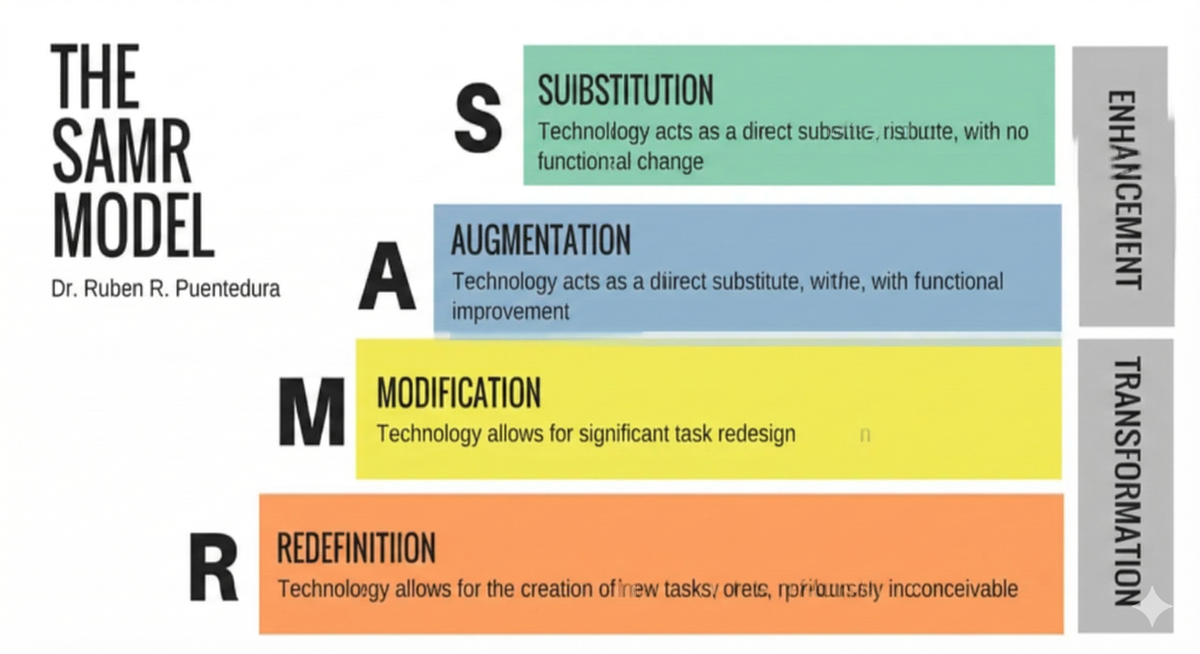
- The current “lift and shift” approach – simply putting paper exams on screens – is stuck at the SAMR model’s Substitution level, where mode effects can actually make assessment worse and still fail to capture power skills like collaboration, creativity and oral communication.
- To tackle the productivity crisis, schools, trusts and universities need to move beyond Substitution to Transformation, using approaches like Adaptive Comparative Judgement to assess rich portfolios, videos and prototypes, and peer-learning features that turn students into active judges and build critical evaluation skills.
- The real problem is not identifying which skills matter but finding robust, digital-native ways to recognise and credential them; if the national “Slow System” won’t move fast enough, the sector must build its own “Transformation lane” now.
👉 How to use: Select your sector above to generate a strategy that moves your assessment from "Substitution" to "Transformation." Copy and paste into ChatGPT, Claude, or Gemini.
The regulator has chosen a slow path for digital assessment. The economy can’t afford to wait. Here is why the future of skills depends on Transformation, not just Substitution.
Evolution not revolution
This week, the exam regulator Ofqual confirmed what many in the sector suspected: the move to digital assessment will be a gentle evolution, not a revolution. Their latest proposal emphasises that "pen and paper remain central" and that high-volume subjects won't see digital exams for the foreseeable future.
For schools worried about the chaos of a "Big Bang" switch, this is reassuring. But for the UK economy, it is a flashing red warning light.
While the assessment system hits the brakes, the skills gap is accelerating. The NFER’s Skills Imperative 2035 warns of a shortfall of 7 million skilled workers in just a decade. The cost of this digital skills gap is already estimated at £63 billion per year in lost GDP.
We are facing a massive tension: The "Slow System" of exams is prioritising stability, while the "Fast World" of work is screaming for agility.
The "Substitution" trap
The problem isn't that we are moving too slowly; it's that we are moving in the wrong direction.
Using the SAMR model of technology adoption, the current industry approach is firmly stuck at the bottom: Substitution.
- Substitution: Taking a paper exam and putting it on a screen. The task doesn't change. The mark scheme doesn't change. The result is identical.
- The Evidence: Ofqual's own evidence base shows that this "lift and shift" approach is fraught with issues. "Mode effects" mean students read shallower on screens and overestimate their knowledge. If we just digitise the past, we risk making assessment worse, not better.
More importantly, Substitution doesn't solve the productivity puzzle. A digital exam paper still cannot measure Collaboration, Creativity, or Oral Communication, the exact "power skills" the NFER says we need to fix our productivity stagnation.
Escaping to "Redefinition"
If the national exam system is going to stay in the "Substitution" lane, then it is up to schools, trusts, and universities to build the "Transformation" lane themselves.
We cannot wait for a permission slip to start teaching and assessing the skills that matter. We need to move to the top of the SAMR model:
- Modification: Changing the method of assessment. Instead of ticking boxes on a rubric (which struggles to capture complex skills), we use Adaptive Comparative Judgement (ACJ). This allows us to assess portfolios, videos, and prototypes with the same reliability as a maths test.
- Redefinition: Changing the role of the student. With features like Peer Learning, students stop being passive test-takers and become active judges. This builds the critical evaluation skills that Ofqual's report says are missing from screen-based reading.
The Productivity Imperative
The skills gap is a quality problem, not a list problem. We don't need better lists of skills; we need better ways to recognise them.
If we continue to rely solely on a "Slow System" that views 2035 skills as "too hard to measure," the UK’s productivity penalty will only grow. The tools to measure these skills already exist. They are robust, digital-native, and ready to deploy.
The regulator has made their choice: Evolution. Now the sector must make ours: Transformation.
