
- Opinion
From Medieval Guilds to AI: How Guild Knowledge is Becoming the Missing Piece for Modern Learning
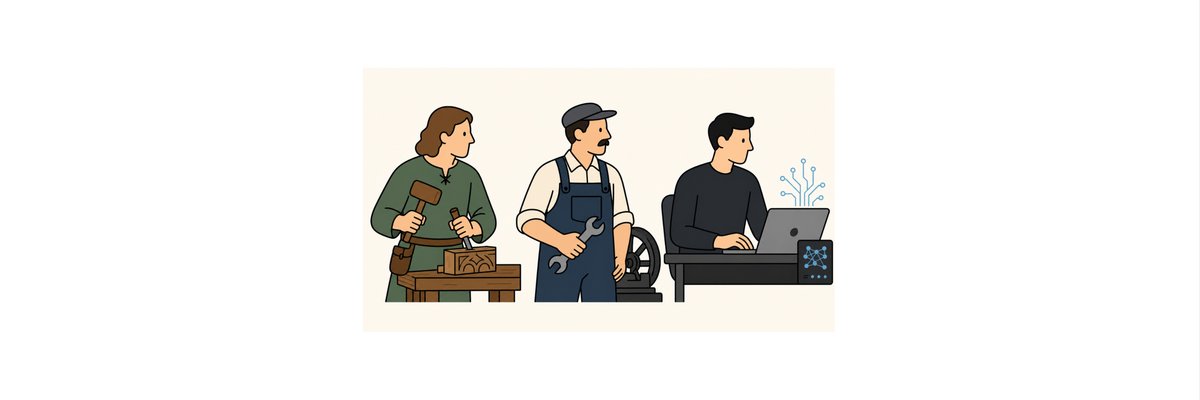
Walk into a medieval guildhall and a modern AI lab and, on the surface, they could not be more different. One smells of timber, leather and metal; the other of coffee and electronics. Yet both are wrestling with the same underlying question: how does a community grow and protect its shared sense of what “good” looks like – and keep that sense of quality alive when everything around it is changing?
At RM Compare we call that shared, experience‑based sense of quality Guild Knowledge. It is what allows a skilled examiner to glance at an essay and know it is a “B+ not an A”, or a seasoned supervisor to see in a moment that a portfolio is solid but not outstanding, even before they have articulated a single criterion. It is not mystical. It is tacit knowledge, the product of repeated exposure to real work and repeated acts of judgement over time.
In this post, we want to tell a longer story about where that idea comes from, why it still matters, and how it can be democratised rather than gate‑kept in an age of AI.
What we mean by Guild Knowledge
Most of us in education and professional development are comfortable with two familiar categories: assessment of learning (the grading at the end) and assessment for learning (feedback along the way). Less often named but arguably more powerful is assessment as learning: the idea that the act of judging quality is itself a learning process, as important as the mark or comment that comes out of it.
D. Royce Sadler’s classic work on formative assessment described how expert teachers carry standards “largely in unarticulated form, inside their heads as tacit knowledge,” and how comparing and discussing student work together creates “a form of guild knowledge.” In other words, Guild Knowledge is what a community comes to know, collectively and often wordlessly, about what counts as good work in that context.
The problem today is not that this kind of knowledge has disappeared. It is that the traditional mechanisms for building and passing it on no longer work as reliably as they once did.
To understand why, it helps to look at how guilds, City & Guilds and the livery companies have already grappled with this problem over the last 800 years, and what that history suggests about the role RM Compare can play now.
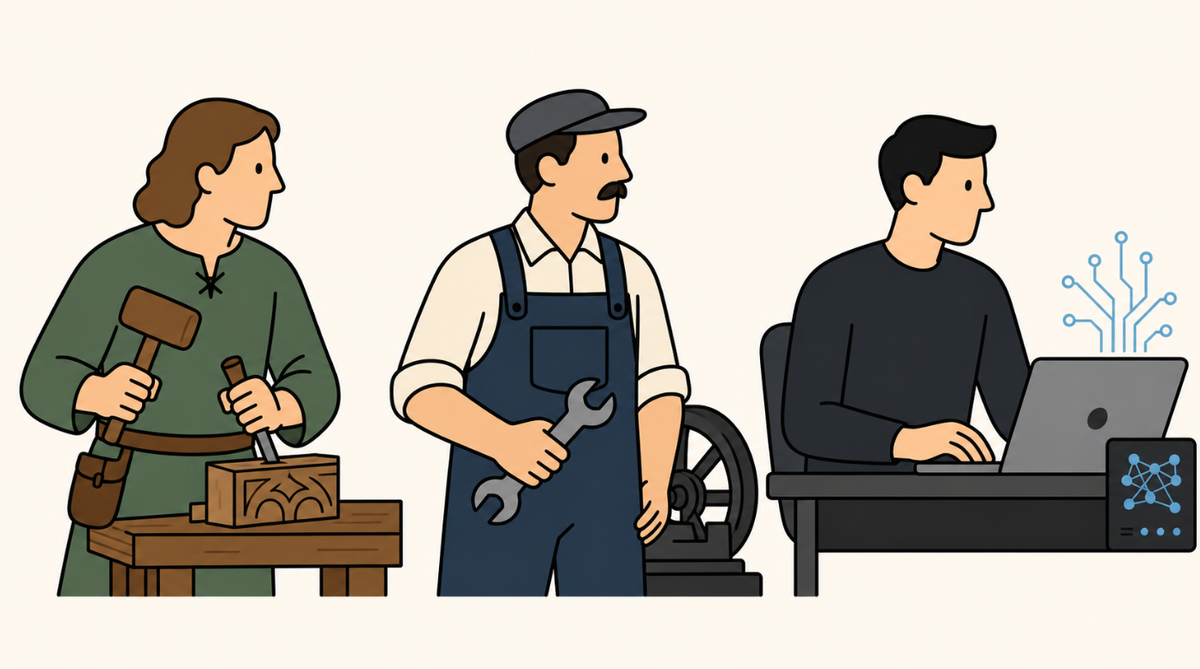
Act 1 – When guilds were the operating system of quality
The original craft guilds of the City of London were, in effect, the quality infrastructure of their time. Livery companies like the Worshipful Company of Goldsmiths or Fishmongers regulated who could trade, what standards products had to meet and how infringements would be punished. If you bought bread or cloth in the City, you were relying on a guild to have done the quality control.
Crucially, that control did not come only from written rules. It rested on a shared eye for quality that was built up inside the guild. Masters and journeymen worked side by side. Apprentices spent years watching work at all levels, from the exemplary to the barely acceptable, and seeing how experienced practitioners reacted. Over time, they internalised those reactions. That is Guild Knowledge in its original form: tacit, communal and powered by comparison.
This is where we need to be candid. Those guilds were not egalitarian. They restricted entry, controlled prices and often entrenched social hierarchies as much as they protected standards. The term “guild” carries that baggage, and it is reasonable for people to be wary of it.
At the same time, the underlying insight remains powerful. When a community has a strong, shared sense of “what good looks like here,” its work tends to be more consistent and more trustworthy. The question is how to preserve that benefit without importing the exclusion that historically came with it.
Act 2 – Industrial disruption and the birth of City & Guilds
By the late nineteenth century, the world that produced the medieval guilds was under intense pressure. The Industrial Revolution had created new technologies, new kinds of work and a new scale of production. Informal apprenticeships and closed craft circles could no longer keep up with the technical skills Britain needed. It began to fall behind other industrial nations with more systematic approaches to technical education.
The response in the City was not to shrug and accept the loss of Guild Knowledge. In 1878, the City of London Corporation and sixteen livery companies met at Mercers’ Hall and founded the City and Guilds of London Institute for the Advancement of Technical Education. Their aim was explicit: to create a national system of technical education, rooted in centuries of experience setting craft standards but fit for the industrial age.
In effect, City & Guilds was an Act 2 solution to the Guild Knowledge problem. Instead of relying on tacit standards living inside a few masters, it set out to codify, assess and certify those standards across whole sectors. Exams, curricula and certification replaced – or at least supplemented – the informal judgement of individual guilds.
This matters for our story because it shows that the guild tradition has already modernised once. When industrialisation broke the old transmission mechanism, the answer was not to abandon Guild Knowledge but to institutionalise and scale it through new forms of education and assessment.
Act 3 – Modern livery companies and the new Guild Knowledge gap
The livery movement itself did not disappear after 1878. It changed shape. Today’s livery companies still carry ceremonial roles, but they also see education, skills and philanthropy as core purposes. Many support schools, colleges and universities; fund scholarships and master‑craftsperson schemes; and back apprenticeships and skills programmes across their trades.
There are now more than a hundred livery companies, including modern entrants like the World Traders and the Tax Advisers, alongside ancient crafts. That in itself tells a story: even twenty‑first‑century professions in finance or tax recognise the need for structures that protect and transmit tacit professional standards, not just formal rules.
City & Guilds, for its part, has continued to evolve. From its nineteenth‑century roots it has grown into a major provider of vocational qualifications, apprenticeships, end‑point assessment and digital credentials. Its mission – to help people and organisations develop the skills they need to thrive – is as relevant now as when it was founded.
And yet, a gap has opened up.
Technical education frameworks do a good job of codifying many skills. But the most important judgements in education and professional life are often about things that are much harder to reduce to tick‑boxes: whether a piece of writing is powerful rather than merely correct; whether a project proposal is genuinely robust or just well presented; whether a clinical interaction is both safe and humane; whether a portfolio really meets the standard or just looks the part.
These are exactly the decisions where Guild Knowledge – that fast, experience‑based recognition of quality – matters most. They are also the decisions where the old assumption that people will “pick the standard up” over years of experience is least reliable, because the conditions that made that possible are eroding.
Curricula are being rewritten more frequently. Roles change faster. Staff turnover has increased. Most significantly, generative AI can now produce plausible‑looking work at the click of a button, making it even harder to rely on surface features as proxies for quality. The informal, slow‑burn apprenticeship into a community’s standards no longer works at the scale and speed we need.
That brings us to Act 4.
Act 4 – RM Compare as distributed Guild Knowledge infrastructure
City & Guilds represents one kind of answer to the Guild Knowledge problem: a central institution that defines and certifies standards for a whole landscape of skills, in partnership with the livery companies and others. In the twenty‑first century, we need a complementary kind of answer.
Tacit standards of quality are now highly contextual. What “good” looks like in one subject, institution or profession may not be what “good” looks like in another. Expectations shift as curricula, technologies and social priorities change. No single external body can hold and refresh those standards on everyone’s behalf.
Instead, each organisation needs a way to build, share and renew its own Guild Knowledge, over and over again, as people come and go and contexts change. And it needs to do that in a world where AI systems can generate fluent but shallow work and where the cost of being fooled by surface polish is higher than ever.
RM Compare can be part of the solution.
Adaptive comparative judgement allows communities of practice to bring many eyes to bear on real work, to compare it directly, and to converge on a defensible rank order that reflects their collective sense of quality, not just an individual’s opinion. Our research on Learning by Evaluating has shown that even short, structured judgement activities can measurably improve the quality of learners’ subsequent work, with particularly strong gains among those who started from lower baselines. In those activities, participants are not just being graded; they are actively developing their own Guild Knowledge.
The RM Compare | ⏱️NOW Guild Knowledge test makes this visible in minutes. You make an initial estimate of quality, you compare pieces of work against one another, and you see how closely your judgements align with a trusted standard, scored from Apprentice through to Master. It is a tiny, compressed version of what guilds, colleges and professions have tried to do over years: give people repeated, meaningful exposure to real examples and a chance to calibrate their judgement.
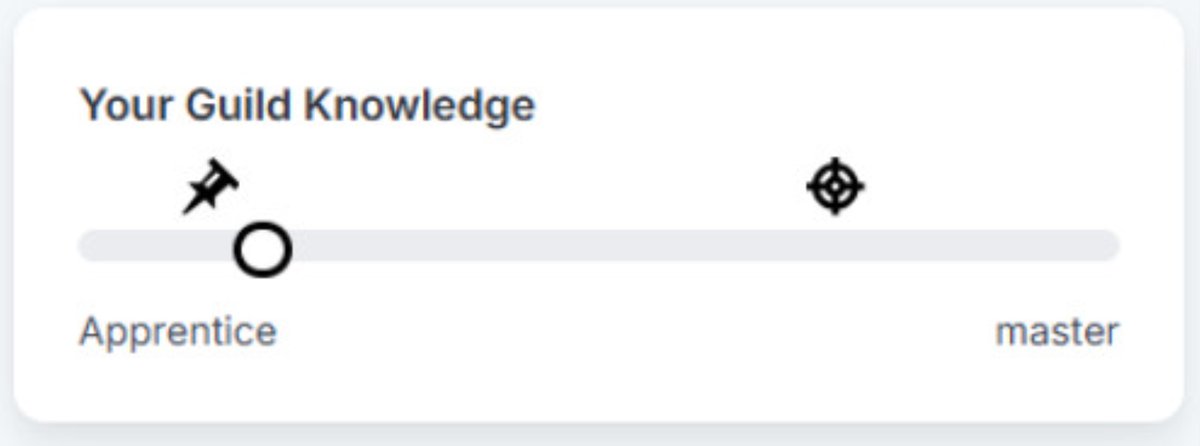
The crucial difference from the medieval model is that this process is open rather than closed. The original guilds restricted entry and kept their tacit standards inside a small group. Modern livery companies and City & Guilds have already moved in the opposite direction, investing heavily in education, scholarships and skills so that more people can reach those standards. RM Compare fits on that side of the story. It is designed to make the processes that build Guild Knowledge available to every teacher in a department, every assessor in an awarding organisation, every member of a professional team – not just a handful of long‑serving insiders.
That is why we are comfortable using a term with such a charged history. When we talk about Guild Knowledge, we are not trying to recreate the gatekeeping structures of the past. We are trying to take the best part of that legacy – a strong, shared sense of quality – and turn it into something any organisation can build, deliberately and equitably, for itself.
In an AI‑rich world, the organisations that succeed will be those whose people can tell the difference between work that merely looks plausible and work that genuinely meets their standard. That is, at heart, a Guild Knowledge problem. Our bet is that comparative judgement, used as assessment as learning, is one of the most powerful tools we have to solve it.