
- Research
What do students learn when they compare?
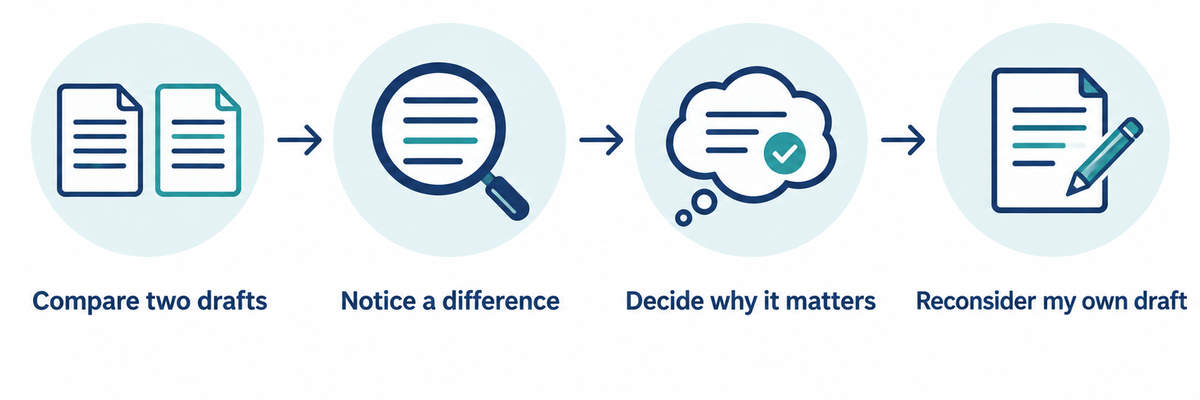
New research suggests that the value of peer comparison lies not only in the feedback students receive, but in the feedback they generate for themselves.
Ask a student to compare two draft essays and decide which is stronger. They may notice that one has a clearer argument, makes better use of evidence, or handles a difficult idea more effectively.
But noticing a difference is not the same as learning from it.
A newly published study, Learning by comparing: internal feedback and evaluative judgement in peer assessment with comparative judgement (Hoffelink et al 2026), examines that distinction. In a master’s course, students compared peers’ draft essays and commented on their quality. The researchers investigated how making those comparisons, and receiving comments from peers, helped students think about the quality of their own work.
Feedback students generate themselves
We often think of feedback as something one person gives and another receives. This study draws attention to internal feedback: the ideas students form about their own work as they encounter, compare and judge other work.
A student reading a peer’s essay might notice an effective introduction. But the potentially useful moment comes when they ask: Why does this introduction work? What does it tell the reader that mine does not?
That is an evaluative judgement. The student is doing more than spotting a difference; they are deciding what that difference means for quality and whether it has implications for their own draft. The essay question here is an illustration of the process, rather than an example reported by the researchers.
The study suggests that comparisons and peer comments both create opportunities for this thinking. Students can learn while judging others’ drafts, and they can learn as they interpret what others have said about their own. What matters is the work they do to make sense of those encounters.
The judgement is a beginning
For those of us working with comparative judgement, this is a valuable shift in emphasis. We can focus so heavily on the choice between A and B that we overlook what is happening in the learner’s mind.
A choice may reveal a preference. An explanation begins to reveal why. Reflection connects that explanation to the learner’s own work.
That does not mean every comparison must be followed by a long written justification. It means we should pay attention to the conditions that help students move from “this is better” to “I understand something about quality that I can use”.
What should we ask next?
The study does not show that every student who compares work will improve their next draft. Nor does it tell us the ideal number of comparisons, the perfect prompt, or which software feature makes learning happen. It is a qualitative investigation of students’ experience in one master’s-course activity.
It does, however, suggest better questions for anyone designing peer assessment:
- What differences do students notice when they compare?
- How do they decide which differences matter?
- Do their explanations change as they encounter more work?
- What do they take back to their own draft?
- Can we see those insights reflected in a subsequent revision?
At RM Compare, we call the wider idea Learning by Evaluating. This research helps make that phrase more precise. Students do not learn simply because they have evaluated something. The opportunity lies in using that evaluation to develop their own understanding of quality, and then acting on it.
Other reading
- RM Compare - Assessment FOR Learning: Peer learning and beyond
- Research: RM Compare, Peer Learning and Student Engagement in HE
- Research: Harnessing Peer Evaluation in Design Thinking - A Dive into Adaptive Comparative Judgement in HE
Note: The study discussed here used Comproved, not RM Compare. Its contribution is insight into the learning process; it is not evidence of the impact of a particular RM Compare feature.