
Blog
Posts for category: Opinion
-
Why the Future of Assessment is a Community Endeavour
Moving beyond the transactional illusion of AI-era education. A student can now sit alone, prompt a machine and produce a polished essay, working code or a plausible solution to a complex problem in minutes. For education, that is more than an administrative headache. It challenges a familiar assumption: that a finished piece of work, submitted out of sight, is reliable evidence of what a student knows, understands or can do.
-

From Marking Errors to Life Earnings: How Comparative Judgement Can Reduce the Risk
If a single grade can change a student’s lifetime earnings, then we can’t afford a grading system that behaves like a lottery. Recent analysis shows that moving just one grade band at A‑level can translate into thousands of pounds more – or less – in annual income over a career.
-
Lessons from a long life - Edgar Morin (1922 - 2026)
Edgar Morin died in Paris on 29 May 2026 at the age of 104, bringing to a close one of the most wide-ranging intellectual lives of the last century. Across that long life he returned, again and again, to one central idea: reality is not made of isolated parts that can be fully understood by breaking them down, but of interwoven systems in which order, disorder, uncertainty, part and whole are inseparable.
-

A better way to use experts
In a recent Observer article, Dennis Sherwood warns that “a single exam result can change a pupil’s life, but grading in England is a lottery.” The piece highlights a stark tension: exam grades carry life‑changing consequences, yet the system’s own regulator acknowledges that many GCSE, AS and A‑level grades are only reliable to within about one grade either way.
-

Skills England Report 2026
The annual Skills England report was issued yesterday. As always it made for interesting reading. Coming on the back of the Interim report from Alan Milburn about the parlous state of youth unemployment and education the stakes could not be higher or more urgent.
-

Resilience Is No Longer Enough: Why Curriculum and Assessment Need Antifragility
For years, we’ve been told that education systems need to be more “resilient”. Resilient curriculum. Resilient assessment. Resilient students. In a world of AI, that sounds reassuring, but it quietly sets the wrong ambition. Resilience, in the way we usually use it, means being able to withstand shocks and stay the same. The problem is that AI is not a one‑off storm. It is a permanent change in the climate.
-

Assessing Big Ideas: Why ACJ Belongs with UbD
UbD (Understanding by Design®) encourages teachers to design authentic performance tasks: essays, presentations, podcasts, investigations, portfolios, prototypes, and other complex responses that make big ideas visible. But when that work has to be judged, the system often falls back on tools and habits better suited to narrower, more standardised forms of assessment.
-
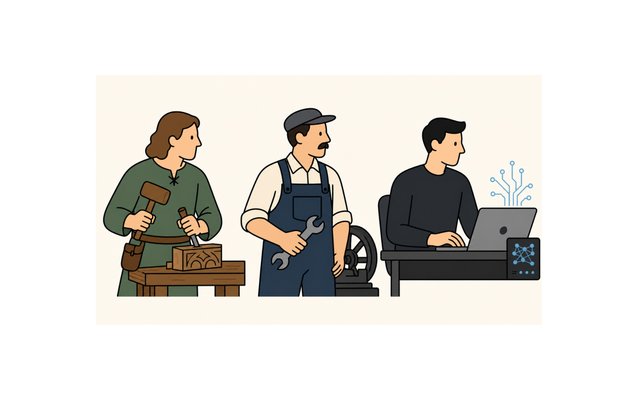
From Medieval Guilds to AI: How Guild Knowledge is Becoming the Missing Piece for Modern Learning
Walk into a medieval guildhall and a modern AI lab and, on the surface, they could not be more different. One smells of timber, leather and metal; the other of coffee and electronics. Yet both are wrestling with the same underlying question: how does a community grow and protect its shared sense of what “good” looks like – and keep that sense of quality alive when everything around it is changing?
-

For 500 years, Guilds were how expertise worked. Then we forgot. Now we're remembering.
The craft guilds of medieval Europe such as goldsmiths, weavers, stonemasons and apothecaries are often remembered as protectionist trade associations. That reputation is not entirely undeserved. But it obscures something more important: they were the most sophisticated knowledge transmission institutions the pre-modern world produced.